


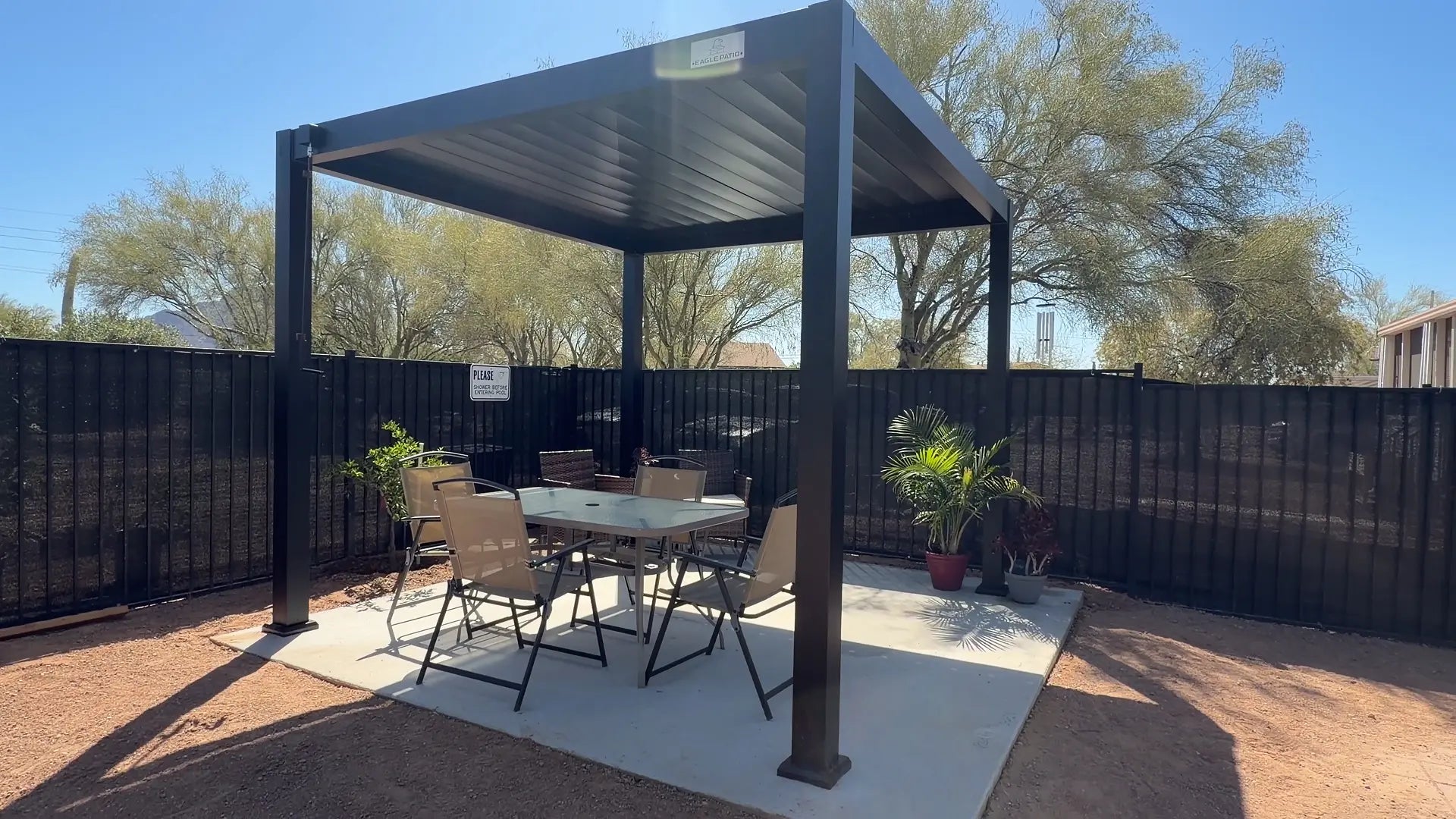
Before choosing a pergola, many homeowners start with size, color, roof style, and price. Those details matter, but they should not be the first question.
Start with one question:
Can your patio support a pergola?
A pergola sits on posts, and each post needs a reliable support path. A concrete patio, paver patio, wood deck, grass lawn, gravel area, or existing slab can each require a different installation approach. Some surfaces may be ready for a standard pergola kit with the right anchors and hardware. Others may need additional foundation planning before you buy.
This guide helps you understand whether your patio surface is likely ready for a pergola, what warning signs to look for, and when to pause before choosing a standard kit.

This is not a construction manual. If you need details about footings, piers, anchors, post bases, frost depth, or deck-integrated foundations, read our foundation guide: How to Build the Perfect Pergola Base Foundation.
Quick Answer: Which Patio Surfaces Can Support a Pergola?
A patio surface that looks flat is not always ready to support a pergola. Some surfaces are structural. Others are mainly decorative or walkable. The difference matters because pergola posts need more than a finished surface under them.
Use this table as a starting point.
| Patio Surface | Surface Readiness | Main Concern | Best Next Step |
|---|---|---|---|
| Concrete patio | Usually easier if the slab is suitable | Cracks, thickness, drainage, edge distance | Check anchor and post base requirements |
| Paver patio | Needs review | Pavers are usually a surface layer, not the structural base | Review foundation options below the pavers |
| Wood or composite deck | Needs structural review | Deck boards are not the main load path | Check deck framing before choosing a kit |
| Grass or soil | Needs foundation planning | Soil stability, drainage, and support depth | Review footings, piers, or approved ground supports |
| Gravel area | Needs below-surface support | Gravel alone is loose material | Confirm what supports the posts below the gravel |
| Existing slab | Maybe, after inspection | Unknown thickness, cracks, or settlement | Inspect before drilling or anchoring |
This table is not an installation approval. It is a readiness guide. If your surface falls into a “needs review” category, do not rush into product selection. First confirm whether the surface, post layout, and installation requirements can work together.
Why Surface Readiness Matters Before Buying a Pergola
A pergola is more than a shade feature. Once installed, it becomes an outdoor structure exposed to wind, rain, sun, seasonal temperature changes, and daily use.
Your patio surface affects:
- How the posts are supported
- Whether anchors, post bases, piers, or footings may be needed
- Whether the pergola stays aligned over time
- Whether water can drain away from the posts
- Whether accessories can be added safely
- Whether the installation matches manufacturer instructions
- Whether a standard pergola kit is a good fit for your space
This becomes even more important if you plan to add privacy screens, curtains, lighting, fans, heaters, or a motorized louvered roof. Accessories can change how the pergola interacts with wind, weight, power access, and long-term use.
In simple terms: the surface under the pergola is part of the buying decision.
Concrete Patio: Usually Easier, But Still Needs Checking

A concrete patio is often one of the easier surfaces for pergola installation, especially when the slab is sound, stable, and well-drained.
Before assuming your concrete patio is ready, check:
- Are there visible cracks near the post locations?
- Is the slab uneven or settled?
- Does water pool where the posts would sit?
- Are the posts too close to slab edges or joints?
- Do the base plates and anchors match the pergola kit requirements?
- Is the slab condition known, or is it older and uncertain?
A suitable concrete patio may work well with a surface-mounted pergola. But damaged, thin, poorly drained, or unknown concrete should be reviewed before drilling.
What this means for standard pergola kits
Concrete patios often pair well with aluminum louvered pergolas and surface-mounted patio pergolas when the slab is suitable. Before choosing a kit, confirm the post spacing, base plate layout, and anchor requirements.
If your concrete condition is unclear, use the foundation guide as your next step before buying.
Paver Patio: Beautiful Surface, But Not Always Structural Support

A paver patio can look strong and permanent, but pavers are usually a finished surface layer. Many paver systems sit over bedding sand and compacted base material. That system may be suitable for walking, furniture, and outdoor living, but it should not automatically be treated as the structural support for a pergola.
The common mistake is thinking that large pavers can hold pergola posts by themselves. Over time, pavers can shift, settle, or loosen.
For many permanent pergola installations, the support needs to reach below the paver layer. That may mean planning footings or piers at the post locations, then finishing the pavers around the posts or bases.
What this means for standard pergola kits
A paver patio may still work well for a freestanding pergola kit, but only when the post layout and below-surface support plan make sense.
Before buying, check:
- Where will each post land?
- Can the pavers be removed or cut at post locations?
- Is there a plan for support below the paver layer?
- Does the standard kit’s post spacing match your patio layout?
If your pavers move under foot pressure, pause before choosing a kit.
Wood or Composite Deck: Check the Framing, Not Just the Boards

A pergola can be installed on some decks, but deck boards alone should not be treated as the main support structure.
Deck boards are mainly the walking surface. The more important question is whether the framing below the boards can support the pergola posts and the forces acting on them, especially over time and under wind, snow, or moisture exposure.
Before considering a deck-mounted pergola, check:
- Where are the joists and beams?
- Is there blocking or reinforced support under the planned post locations?
- Is the deck raised, floating, or attached to the home?
- How old is the deck?
- Are there signs of movement, rot, rust, water damage, or repair?
- Can the pergola be connected to structural framing instead of only to deck boards?
- Does water pool where the posts would sit?
What this means for standard pergola kits
Do not choose a pergola based only on deck size. If the framing cannot be confirmed, concrete footings, added structural support, or placing a freestanding pergola near the deck may be safer and more practical than mounting directly on the deck boards.
Grass or Soil: Flexible Layout, But Requires a Real Support Plan

A backyard lawn can be a great place for a pergola. It gives you flexibility to create a dining area, lounge space, poolside shade zone, or garden retreat.
But grass and soil are not a finished structural surface. Pergola posts usually need a support method that reaches stable ground.
That may involve:
- Concrete footings
- Concrete piers
- Approved ground screws
- Engineered ground anchors
- Another manufacturer-approved support method
Soil conditions matter. Wet, soft, recently disturbed, rocky, or poorly drained soil may change the foundation plan.
If digging is required, contact 811 before excavation or your local utility-locate service before excavation.
What this means for standard pergola kits
Grass and soil areas often work well with freestanding backyard pergolas when the post layout and support plan are clear. Before buying a kit, confirm the required post spacing and foundation approach.
Gravel Area: Good for Drainage, Not Enough by Itself

Gravel can help with drainage and create a clean outdoor surface, but loose gravel should not be treated as the structural base for a pergola.
A pergola over gravel still needs a reliable load path below the surface. The posts may need to connect to footings, piers, ground screws, or another approved support method that reaches stable ground.
Before planning a pergola over gravel, check:
- How deep is the gravel layer?
- What is under the gravel?
- Is the soil stable?
- Can the post locations align with real support points?
- Will hardware remain accessible for inspection or maintenance?
- Will water drain away from the post bases?
What this means for standard pergola kits
A gravel area may work for a freestanding pergola if the support system extends below the gravel. Do not assume that gravel alone can hold the pergola in place.
Existing Slab: Inspect Before Anchoring
An existing slab can look like a ready-made base, but older concrete should be inspected before drilling.
Check for:
- Cracks
- Surface damage
- Settlement
- Unknown thickness
- Poor drainage
- Edge distance
- Joint locations
- Previous repairs
- Soft or broken areas around the planned post locations
If the slab is suitable, a surface-mounted pergola may be possible. If the slab is damaged or uncertain, review the foundation requirements before choosing a standard kit.
When to Pause and Request a Patio Fit Check
You do not need a perfect patio to consider a pergola. But some surface conditions should make you pause before choosing a standard kit.
Request a patio fit check before buying if:
- Your concrete patio has visible cracks, settlement, or unknown thickness
- Your pavers shift, move, or sit over sand
- Your deck is raised, older, floating, or has hidden framing
- Your soil is wet, soft, recently disturbed, or poorly drained
- Your gravel area has no known structural support below it
- Your post locations are close to slab edges, joints, steps, or slopes
- You plan to add privacy screens, curtains, fans, heaters, lights, or motorized features
- You need to dig but have not contacted 811 or a local utility-locate service
- You are unsure whether a standard pergola kit fits your patio layout
These conditions do not always mean your project cannot work. They simply mean the installation plan should be reviewed before you buy.
For a quick patio fit check, helpful details include:
- Your patio surface type
- Approximate patio size
- Photos of the full installation area
- Close-up photos of cracks, pavers, slab edges, steps, slopes, or deck framing if visible
- The pergola size or model you are considering
- Any planned accessories, such as screens, lights, fans, heaters, or slat walls
- Whether the area is exposed to strong wind
- Any known HOA or permit requirements
The goal is not to create a custom design. It is to help you understand whether your surface appears compatible with a standard pergola kit, or whether you should review foundation requirements first.
Not sure if your patio can support a pergola? Share your surface type and photos for a quick fit check. Check My Patio Fit
Before You Move to Product Selection
Once you understand your surface condition, you can make a better product decision.
Before choosing a standard pergola kit, confirm:
- Available space
- Post spacing
- Base plate layout
- Installation surface
- Anchor or foundation requirements
- Drainage around post locations
- Planned accessories
- Local permit or HOA rules
- Manufacturer installation instructions
If the surface is straightforward, you may be ready to compare standard pergola kits. If the surface is complex, your next step should be the foundation guide.
For projects involving footings or frost-depth concerns, always check local footing and frost-depth requirements before installation.
Read Next: How to Build the Perfect Pergola Base Foundation
FAQs About Patio Surface Readiness
Can my patio support a pergola?
It depends on the surface and condition. Suitable concrete may support a surface-mounted pergola, while pavers, soil, gravel, and some decks often need additional review or foundation planning.
Can you install a pergola on concrete?
Yes, if the concrete is suitable for anchoring. Check cracks, drainage, edge distance, and manufacturer hardware requirements before drilling.
Can you install a pergola on pavers?
Possibly, but pavers alone should not be assumed to support a pergola. A permanent installation often needs support below the paver layer.
Can a pergola be installed on a deck?
Yes, but only if the deck framing can support it. Pergola posts should not be fastened only to deck boards.
Can you put a pergola on grass?
Yes, but grass or soil usually needs footings, piers, approved ground screws, or another proper support method.
Can you install a pergola on gravel?
Possibly, but gravel alone is not structural support. The pergola usually needs support below the gravel layer.
Should I check my patio before buying a pergola kit?
Yes. Before buying, confirm your surface type, available space, post spacing, base plate layout, drainage, and installation requirements.


