


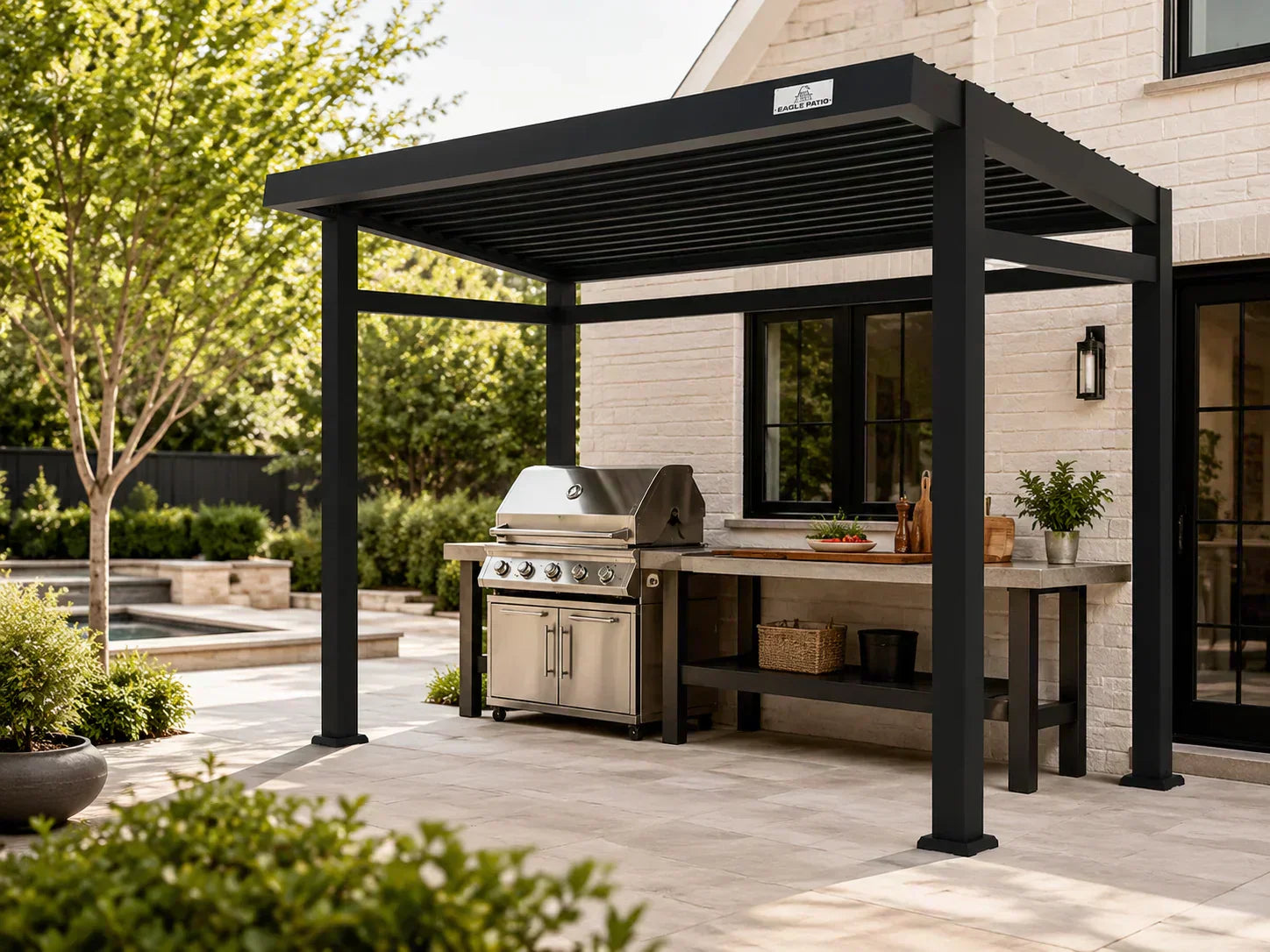
A covered grill area can make backyard cooking feel easier, cooler, and more social. But a good setup should not start with the roof style. It should start with the basics: the surface, the grill clearance, the airflow, the rain path, and how people actually move around the cooking zone.
Many homeowners start with a photo of a beautiful outdoor grill station and think, “I want that.” The harder questions usually come later.
- Is the patio stable enough?
- Will smoke collect under the cover?
- Is the grill too close to a wall or fence?
- Can the grill lid open without hitting the roof?
- Will rainwater drain toward the house?
- Is there enough room for food prep and guests?
This checklist will help you plan a covered grill area before choosing a pergola, grill shelter, or outdoor bar setup.
A pergola can create shade and define the grilling zone, but it should never replace your grill manual, the pergola installation instructions, local codes, or basic fire-safety planning.
The U.S. Fire Administration recommends using propane, charcoal, and wood pellet grills only outdoors, placing grills away from siding, deck railings, eaves, and overhanging branches, and maintaining a 3-foot safety zone around the grill. You can review the complete USFA outdoor grill safety guidance.
Important: The 3-foot safety zone is a general fire- and burn-safety guideline. It does not replace the grill manufacturer’s required clearance from walls, overhead structures, or combustible materials.
Covered Grill Area Checklist
Before adding a cover over your grill area, check these seven things:
|
What to check |
Why it matters |
What to look for |
|
Supports stable anchoring |
Level concrete or another properly supported foundation |
|
|
Grill clearance |
Reduces heat and fire risks |
Follow the grill manual and applicable local requirements |
|
Airflow |
Helps smoke and heat move out |
Open sides, adjustable louvers, and an unobstructed smoke path |
|
Rain and drainage |
Keeps water from pooling |
Roof runoff, patio slope, gutters, and side-rain exposure |
|
Cooking layout |
Makes grilling easier |
Room for the grill, lid opening, prep surfaces, and tools |
|
Guest traffic |
Keeps people away from heat |
Clear walking paths outside the cooking zone |
|
Lighting and storage |
Supports evening BBQs |
Task lighting, counters, hooks, and tool storage |
A covered grill area is not just about keeping sun off your face. It should make cooking more comfortable without creating new problems around heat, smoke, water, or crowding.

Start With the Patio Surface and Pergola Base
A grill pergola is not patio furniture. Once it is anchored, the surface becomes part of the whole setup. That is why the patio base should be checked before the grill, bar counter, or furniture layout.
Concrete Patio
A concrete patio is often the easiest surface to evaluate because it is usually more stable and anchor-friendly than loose materials. Still, you should check for cracks, slope, edge distance, and whether the slab is level enough for a pergola base.
If the patio slopes toward the house, rainwater and grease cleanup may become a long-term problem. If the slab is cracked or thin, it may need additional review before anchoring.
Paver Patio
Pavers can look solid on the surface, but the real question is what is underneath. A paver patio sitting on sand or gravel may shift over time, especially if posts are anchored only into loose pavers.
Before installing a grill pergola on pavers, check whether the paver base is stable, whether footings are needed, and whether the installation method matches the pergola manual. Do not assume that a clean-looking patio is ready for structural anchoring.
Wood or Composite Deck
Deck setups need extra care. You are not only checking the deck boards. You are checking the joists, beams, posts, and overall load path.
A grill, a pergola, people, and furniture all add weight. Heat and grease also matter. If your grill area is on a deck, confirm the structure can support the setup before treating it like a standard patio.
Grass, Gravel, or Uneven Ground
Grass, soil, and loose gravel usually need more foundation work before supporting a fixed pergola. They may require concrete footings, a slab, or another stable base.
This is where it may be smarter to pause, take photos, measure the space, and review your options before buying.
Check Grill Clearance Before Adding Any Cover
Shade should never be the reason a grill gets placed too close to a wall, fence, roofline, or guest seating area.
Different grills have different clearance requirements. Gas grills, charcoal grills, pellet grills, smokers, and griddles should not be treated the same. Always follow the grill manufacturer’s manual first. Local fire rules, HOA guidelines, and appliance instructions may be stricter than a general backyard planning article.
Watch the areas around the grill:
- House siding
- Deck railings
- Eaves and rooflines
- Fences
- Windows and doors
- Overhanging branches
- Furniture
- Guest walkways
A pergola can help define and shade a cooking area. It does not make an unsafe grill placement safe.
The safest wording to keep in mind is simple: comfort features come after clearance. If the grill manual requires more space, adjust the layout before adding a cover.
Plan Airflow Before You Think About Shade

In a covered grill area, shade is the obvious benefit. Airflow is the hidden test.
Smoke behaves differently under a roof or pergola. If the grill area is open on multiple sides, smoke and heat have more room to move. If the grill sits in a corner with a house wall behind it, a fence on one side, and a cover above it, the space may feel too enclosed.
Before choosing a grill shelter, ask:
- Is the grill area open enough on the sides?
- Is the grill too close to a wall or fence?
- Can heat rise and move away?
- Will guests block the open path?
- Can the roof be adjusted during cooking?
This is where a louvered pergola can be useful. Adjustable louvers can help you tune shade and airflow while cooking. EaglePatio’s N5 grill pergola, for example, uses louvers that tilt up to 90° so users can open them for airflow and sunlight or close them for shade and protection.
Still, louvers are not magic smoke removers. Smoke control depends on grill type, wind direction, nearby walls, and how open the surrounding area is.
A good airflow example is a grill under a pergola with open sides, louvers opened during cooking, and no wall directly behind the smoke path.
A poor airflow example is a grill tucked into a narrow corner with fencing, siding, furniture, and a low cover all around it. That setup may look cozy in photos but feel smoky in real use.
Think About Rain From the Top

A covered grill area can help with overhead rain, but most backyard weather problems come where the water goes after it leaves the roof.
Overhead rain is the water falling directly from above. A louvered roof or covered grill shelter can reduce how much of that reaches the grill area.
Drainage also matters near the house. Look at where rainwater flows after it leaves the structure. Does it move toward the lawn? Toward a drain? Toward the back door? Toward the foundation?
EaglePatio’s N5 uses an 8° sloped roof and a rain management system that guides water into built-in gutters and down through the back posts. The N5E also uses a concealed gutter system that channels rainwater through the beams and posts, with separated water and electric systems. That kind of drainage can help manage roof runoff.
Leave Room for Cooking, Prep, Serving, and Guests
A covered grill area works best when the cook is protected, the food has a place to land, and guests can stay close without crowding the heat zone.
Think in zones.
Cooking Zone
This is the grill, smoker, griddle, or cooker itself. Leave room for the grill lid to open, for the cook to stand comfortably, and for heat to move away.
Prep Zone
This is where plates, tools, seasoning, raw food, and trays go. Without prep space, every cookout turns into repeated trips between the grill and kitchen.
Serving Zone
This can be a side table, counter, bar top, or drink station. It keeps guests from gathering directly beside the grill.
Guest Traffic Zone
People should not have to walk through the cooking zone to reach a chair, cooler, or back door. If the layout forces guests to pass behind the grill, the space may need to be reworked.
For a simple setup, a grill shelter may be enough. For a hosting-focused setup, counter space, lighting, and tool storage may matter as much as the cover itself.
Simple Grill Shelter vs Grill Bar Setup: Which Fits Your Patio?
The right covered grill area depends less on the product name and more on how you cook.
If you mostly need shade over one standalone grill, a compact grill shelter may be enough. If you cook with multiple grills, host guests, serve drinks, or grill after dark, a more complete grill bar setup may make more sense.
|
User Need |
Better Fit |
Why |
|
One standalone grill |
N5 Lite |
Compact shelter for basic grilling |
|
Multiple grills or grill + prep station |
N5 Plus |
Wider coverage while keeping a slim depth |
|
Small patio or side yard |
N5 |
Space-saving covered grill area |
|
BBQ + drinks + guests |
N5 E |
Countertops and bar-style flow |
|
Evening grilling |
N5 E |
Integrated lighting helps after dark |
|
Tool organization |
N5 E |
Pegboard and hooks keep tools close |
EaglePatio’s N5 Lite is 7.2’ × 6.6’ and designed for a single standalone grill, while the N5 Plus is 11.8’ × 6.6’ and built for multiple grills or a cooking-and-prep setup.
The N5 E adds dual-side countertops for food prep, drinks, or socializing, plus RGB LED lighting and pegboard storage for tools.
A grill bar pergola does not replace a full built-in outdoor kitchen. It sits between a basic grill cart and a major outdoor kitchen project. For many homeowners, that middle option is exactly the point.

When to Pause Before Building a Covered Grill Area
Sometimes the smartest move is to stop and review the space first.
Pause before installing if:
- Your grill manual requires more clearance than the space allows.
- The area is too enclosed for smoke and heat to move out.
- The patio surface is cracked, uneven, or unstable.
- Pavers shift underfoot.
- A deck has not been checked structurally.
- Rainwater drains toward the house.
- You need gas, electrical, or permit work.
- HOA approval is unclear.
- You expect full storm protection from a covered structure.
A covered grill area should make outdoor cooking easier. It should not create fire risk, drainage problems, or a smoky corner that no one wants to use.
Covered Grill Area Examples by Scenario
Narrow Side Yard Grill Setup
A narrow side yard can work well if the grill does not block the walking path. Keep the setup slim, open, and easy to access. A compact shelter like the N5 Lite may fit this use case if clearance, airflow, and surface conditions are all acceptable.
Single Grill Patio Setup
For one gas grill or charcoal grill, you may not need a full outdoor kitchen. Focus on shade, stable anchoring, open sides, and a small prep surface.
Multi-Grill or Grill + Smoker Setup
Multiple cookers need more width, more airflow, and more planning. Smoke and heat can build quickly if the layout is too tight. A wider cover may help, but only if the space remains open enough.
Grill Bar for Casual Hosting
If your BBQ area is also where people stand, drink, and talk, counter space changes the experience. This is where a grill bar setup like the N5 E makes more sense than a simple shelter.
Rain-Prone Backyard Setup
If sudden showers are common, look at both roof drainage and side exposure. A built-in drainage system can help with overhead rain, but wind-driven rain still needs to be considered.

Final Covered Grill Area Planning Checklist
Before choosing a pergola or grill shelter, collect these details:
- Grill type and model
- Grill width, depth, and lid-open height
- Patio size
- Surface type
- Nearby walls, fences, windows, doors, and eaves
- Drainage direction
- Main wind exposure
- Guest walking path
- Whether you need prep space
- Whether you grill after dark
- Local code or HOA concerns
- Photos from several angles
The best covered grill area is not always the biggest one. It is the one that fits your surface, grill type, airflow, and hosting style.
If you are unsure, share your patio size, surface type, grill dimensions, and a few backyard photos with the EaglePatio team. A quick layout review can help you decide whether a compact grill pergola or a grill bar setup makes sense.
FAQ
Can you grill under a pergola?
In some open-air setups, yes. But you need to follow your grill manual, local code, clearance requirements, and airflow guidelines. A pergola can improve shade and comfort, but it does not replace safe grill placement.
What should I check before creating a covered grill area?
Start with the patio surface, pergola base, grill clearance, airflow, drainage, guest traffic, lighting, and prep space. If any of those are unclear, pause before buying or installing.
Will smoke get trapped under a pergola?
It depends on the grill type, wind direction, louver position, nearby walls, and how open the space is. Adjustable louvers can support airflow, but they do not guarantee smoke removal in every layout.
What surface is best for a grill pergola?
A stable, level, anchor-ready surface is best. Concrete is often easier to evaluate. Pavers, decks, gravel, grass, and uneven ground usually need closer review.
Is a grill pergola the same as an outdoor kitchen?
No. A grill pergola creates a covered cooking zone. A full outdoor kitchen usually includes built-in appliances, cabinets, plumbing, utilities, and more construction. A grill bar pergola can sit between the two.
Can I use a covered grill area in light rain?
A covered grill area can help reduce overhead rain. Side rain, wind direction, and drainage still matter.
Do I need a permit for a covered grill area?
Permit requirements depend on your location, structure size, anchoring method, HOA rules, and whether gas or electrical work is involved. Check local requirements before installation.
How much clearance does a grill need under a cover?
There is no universal clearance number for every grill and cover. Check your grill manufacturer’s manual first, then confirm local code and surrounding materials. If the required clearance does not fit your patio, do not add a cover until the layout is adjusted.
Can a covered grill area go on pavers?
It may be possible, but pavers should not be judged by appearance alone. Check the paver base, movement, anchoring method, and product installation requirements before placing a fixed grill pergola on a paver patio.


