


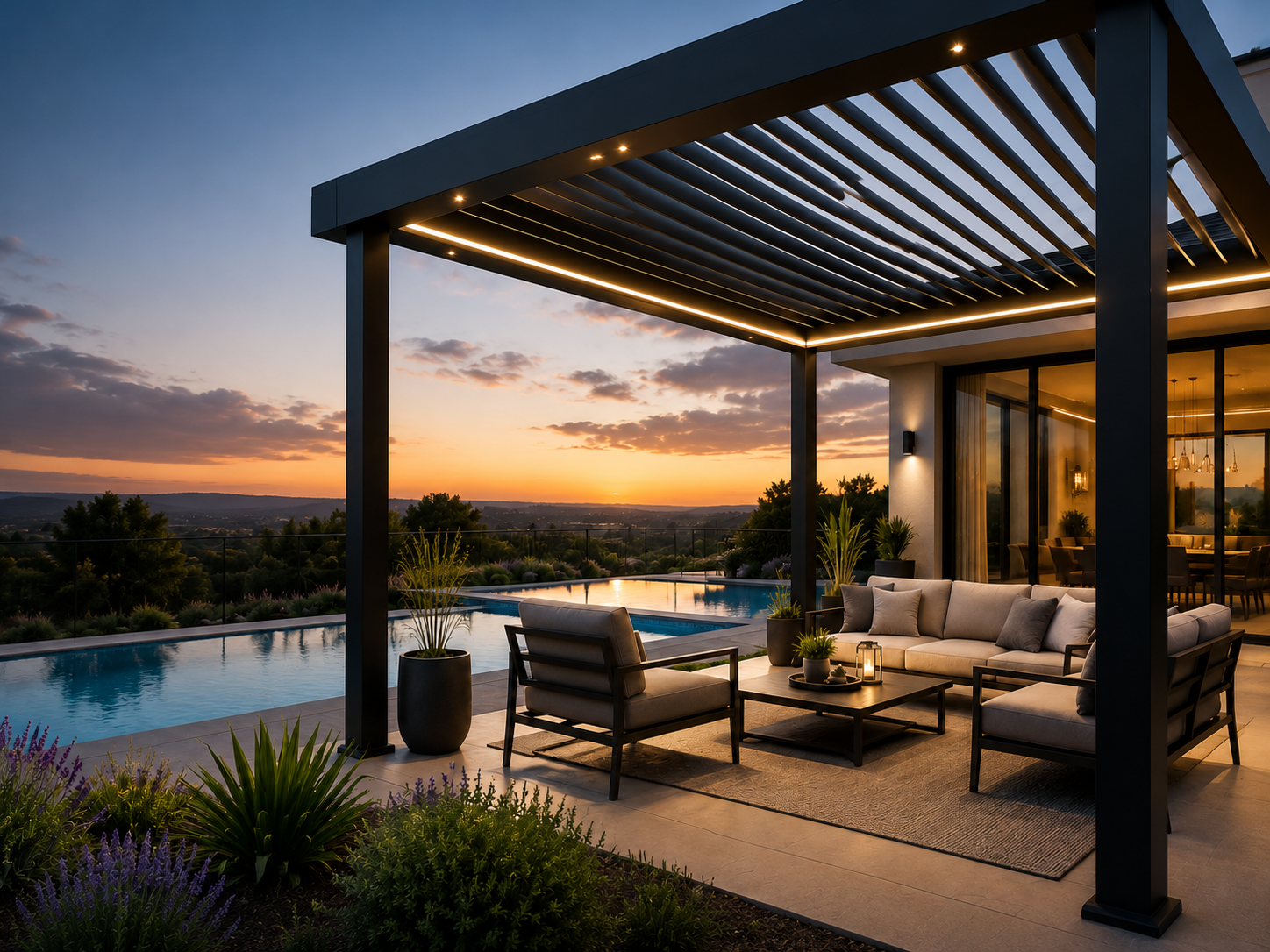
A louvered pergola is an outdoor structure with an adjustable aluminum roof that rotates from fully open (100% sunlight) to fully closed (complete rain protection). In 2026, prices range from $2,000 for DIY kits to $55,000+ for custom commercial-grade installations. The most popular 10'×10' models cost $5,000–$16,000. Quality aluminum systems last 15–25+ years with roughly 45 minutes of annual maintenance. Key buying factors include aluminum alloy grade (6061-T6 vs 6063-T5), motor quality, wind rating (40–130+ mph), integrated drainage, and coating warranty. Louvered pergolas outperform traditional fixed pergolas in year-round usability, weather protection, and long-term cost-effectiveness.
What Is a Louvered Pergola?
A louvered pergola is a modern outdoor structure that gives homeowners full control over their backyard environment through an adjustable roof system. Unlike traditional pergolas with fixed beams that offer only partial, unchangeable shade, a louvered pergola features horizontal blades — called louvers — that rotate on a central axis. You can open them completely to welcome sunlight, close them tightly to block rain, or angle them to any position in between for the perfect balance of shade and breeze. This kind of versatile outdoor living solution has rapidly become one of the fastest-growing segments in home improvement, with North American adoption growing over 20% year-over-year according to recent industry reports. Whether you're envisioning a rain-proof outdoor dining area, a shaded pool lounge, or an all-season entertaining space, a louvered pergola delivers a level of environmental control that no traditional structure can match — and that's precisely why it has become the centerpiece of modern outdoor structure design.
The concept originated in Europe as "bioclimatic pergolas," designed to create livable outdoor spaces regardless of weather conditions. The global bioclimatic pergola market reached roughly $1 billion in 2025 and is projected to grow at over 8% annually through 2032, driven by smart home integration and the broader cultural shift toward outdoor living. In the United States, this growth has been even more dramatic as homeowners increasingly view their backyards as extensions of their interior living spaces — complete with climate control. Modern louvered pergola systems now integrate with home automation platforms, include weather sensors for autonomous operation, and feature built-in LED lighting, speakers, and heating elements. For an in-depth look at how smart home technology integrates with outdoor spaces, explore our detailed guide.
How Does a Louvered Pergola Work?
The engineering behind a louvered pergola is elegant in its simplicity. Each louver blade is an extruded aluminum panel, typically 6 to 10 inches wide, mounted on bearings at both ends within a structural frame. A drive mechanism — either a hand crank, electric motor, or solar-powered actuator — rotates all blades simultaneously through a connecting rod system. When you press a button on your remote control, tap your smartphone app, or when a rain sensor triggers automatically, the motor turns the connecting rod, which rotates every louver in unison from 0° (fully closed and flat, creating a solid waterproof surface) to 135° or more (fully open for maximum airflow).
The watertight performance depends on the seal design between adjacent louvers. Premium systems use a tongue-and-groove or overlapping profile so that when louvers close, they form an interlocking surface with no gaps. Integrated gutter channels along the side beams collect runoff and direct it through hollow posts to ground-level drainage — a critical engineering feature that separates well-designed systems from budget imitators that leave you with waterfalls at every seam.
Smart models add a layer of automation that turns your pergola into a truly responsive structure. Rain sensors detect the first drops and close the louvers within seconds. Wind sensors can open louvers or lock them at a safe angle during high gusts to prevent structural stress. Temperature sensors adjust blade angles throughout the day to optimize shade as the sun moves. Some high-end systems even integrate with weather forecasting APIs, pre-adjusting louvers before a storm arrives.
Types of Louvered Pergola Systems
Understanding the different types of louvered pergola systems is the first step toward making the right purchase decision. The market in 2026 has matured into three distinct categories, each serving different needs, budgets, and skill levels.
Manual Louvered Pergolas
Manual systems use a hand crank or lever to rotate the louvers. They are the most affordable option, typically costing $2,000 to $6,500 installed, and they eliminate potential motor failure points entirely. The trade-off is convenience: you physically turn the crank each time you want to adjust shade or close up before rain. For homeowners who primarily use their outdoor space on fair-weather weekends, a manual system offers excellent value. There are no electricity costs, no wiring requirements, and no electronic components to repair.
Motorized Louvered Pergolas
Motorized systems use electric motors (typically 24V DC or 110V AC) to rotate the louvers via remote control or wall switch. Prices range from $6,500 to $18,000 installed. This is the most popular category for residential use because it balances convenience with reasonable cost. One press of a button adjusts the entire roof in seconds. The motor is typically housed inside a beam and connected to louvers through a gear-and-rod assembly. Quality motors should operate quietly (under 50 dB) and include thermal overload protection.
Smart Automated Pergolas
Smart systems build on motorized operation by adding weather sensors, Wi-Fi connectivity, and app control. Prices range from $10,000 to $25,000+ installed. These are "set and forget" systems: the pergola opens on sunny mornings, adjusts shade as the sun tracks across the sky, closes automatically when rain starts, and locks louvers at safe angles during high winds. Some models feature voice control through Alexa or Google Home, scheduling capabilities, and integration with broader home automation systems. The emerging standard in 2026 is solar-powered smart pergolas, which eliminate the need for hardwired electrical connections entirely.
Louvered Pergola vs Traditional Pergola: A Complete Comparison
The choice between a louvered pergola and a traditional pergola comes down to a fundamental question: do you want fixed partial shade, or complete control over your outdoor environment? Here's how they stack up across every factor that matters.
| Feature | Louvered Pergola | Traditional Pergola |
|---|---|---|
| Shade Control | Fully adjustable, 0°–135°+ | Fixed partial shade only |
| Rain Protection | Full protection when closed | None — open beam design |
| Materials | Powder-coated aluminum | Wood, vinyl, or aluminum |
| Typical Cost | $4,000 – $25,000+ | $1,500 – $8,000 |
| Annual Maintenance | $50 – $200 (rinse & lubricate) | $300 – $800 (stain, seal, repair) |
| Lifespan | 15 – 25+ years | 10 – 15 years (wood) |
| Year-round Usability | All seasons | Fair weather only |
| Smart Home Integration | Available on smart models | Not available |
| Aesthetic | Modern, sleek, minimalist | Classic, rustic, traditional |
| Property Value Impact | Significant increase | Moderate increase |
The upfront cost of a louvered pergola is undeniably higher. But the total cost of ownership over 10 years often favors the louvered system. A wood pergola that costs $3,000 less upfront but requires $5,000 more in maintenance over a decade is not actually the cheaper option. When you factor in the dramatically increased usability — being able to enjoy your patio during rain, extreme sun, or unpredictable spring weather — the louvered pergola becomes less of a luxury and more of a practical investment in your daily quality of life. For homeowners planning to stay in their home for 5+ years, the return on investment is compelling. To learn more about boosting your home's value through outdoor upgrades, read our guide to outdoor improvements that increase property value.
Key Benefits of a Louvered Pergola for Homeowners
The popularity of louvered pergolas isn't just about trend — it's about solving real problems that homeowners face with their outdoor spaces. Here are the benefits that drive purchasing decisions:
✓ Advantages
- Complete control over sunlight, shade, and ventilation at any time of day
- Full rain protection when louvers are closed — no more scrambling indoors
- Year-round outdoor living in all weather conditions
- Reduces indoor cooling costs by shading adjacent rooms and windows
- Dramatically increases usable outdoor hours per year
- Aluminum construction means minimal maintenance — no staining, sealing, or painting
- Modern aesthetic complements contemporary architecture
- Increases property value and buyer appeal
- Smart models automate climate control entirely
- Built-in drainage prevents water pooling
✗ Considerations
- Higher upfront cost than traditional pergolas ($4,000–$25,000+)
- Motorized systems have mechanical components that can eventually fail
- Not ideal for extreme snow loads unless specifically engineered
- Requires a solid foundation (concrete pad or reinforced deck)
- May require building permits in some jurisdictions
- Budget models may develop issues within 5–10 years
- Less "rustic charm" than wood — won't suit every aesthetic
The single biggest benefit that owners report is simple: they use their outdoor space far more often. When you can adjust your pergola in seconds to respond to changing weather, your patio transforms from an occasional fair-weather luxury into a daily living area. Morning coffee in gentle sunlight, afternoon shade for reading, a dry outdoor dinner even when it drizzles — a louvered pergola makes all of this effortless.
Materials: Why Aluminum Dominates the Louvered Pergola Market
Every serious louvered pergola manufacturer in 2026 uses aluminum as the primary structural material, and the reasons are rooted in engineering physics rather than marketing preference.
Corrosion Resistance
Aluminum naturally forms a thin oxide layer on its surface that acts as a built-in corrosion barrier. Unlike steel, which rusts aggressively when its coating is scratched, aluminum self-heals. This makes it particularly valuable in coastal areas where salt air accelerates metal degradation, and in humid climates where moisture is constant. A quality powder coat adds a second layer of protection and provides color options, but even bare aluminum resists outdoor conditions well.
Strength-to-Weight Ratio
Aluminum delivers high structural strength without excessive weight, which makes shipping practical and installation manageable. A fully assembled 10'×13' aluminum louvered pergola typically weighs 250 to 450 pounds for a standard kit, or 1,000 to 1,800+ pounds for a commercial-grade system. The alloy grade matters enormously: 6061-T6 offers a tensile yield strength of approximately 40,000 PSI — nearly 2.5 times stronger than the 6063-T5 alloy (approximately 16,000 PSI) used by many budget manufacturers. That difference translates directly into wind and snow load capacity.
Precision Fabrication
Aluminum can be extruded into complex cross-sectional profiles, which is critical for louver channels, integrated gutter systems, and precision connection points. Each louver needs to rotate smoothly in its housing, seal tightly against its neighbor when closed, and maintain dimensional consistency across spans of 10 to 20+ feet. Aluminum delivers this dimensional precision at manufacturing tolerances that wood and vinyl simply cannot achieve.
Virtually Zero Maintenance
Unlike wood pergolas that require annual staining, sealing, and inspection for rot, or vinyl that can crack and yellow under UV exposure, aluminum needs only an occasional rinse with a garden hose. There's no painting, no staining, no sealing — ever. The powder coat finish resists UV fading for 15+ years on quality systems. This "rinse and forget" maintenance profile is one of the strongest selling points for busy homeowners.
How Much Does a Louvered Pergola Cost in 2026?
The louvered pergola market in 2026 spans an enormous price range — from $2,000 import kits to $55,000+ custom dealer installations. Understanding what drives these price differences is the single most important step in making an informed purchase. The price you pay reflects the aluminum grade, motor quality, coating durability, engineering documentation, and warranty backing — not just square footage.
What Drives Cost Differences?
Size is the most obvious factor — pergolas are priced per square foot, and a larger structure requires more material and longer installation time. But beyond square footage, five factors explain most of the price variation between systems:
1. Aluminum alloy grade and wall thickness: Premium systems use 6061-T6 aluminum with thicker wall profiles. This adds 30–60% to material costs but dramatically improves wind and snow load ratings.
2. Motor and drive system quality: Budget motors are the most common failure point. Quality German or Japanese motors cost more but last 15–20 years vs. 3–5 years for generic motors.
3. Coating system: A multi-layer powder coat process (cleaning, etching, priming, top coat, clear coat) resists UV fading and chipping far longer than a single-stage powder coat. Look for coating warranties as a separate document.
4. Drainage engineering: Premium systems integrate concealed gutter channels in the beams and route water down through hollow posts. Budget systems often rely on simple overlap without drainage, leading to leaks.
5. Structural engineering documentation: Reputable manufacturers provide stamped engineering calculations, wind load reports, and building permit support. If a manufacturer cannot provide these, their structural claims may be unverifiable.
Professional installation typically adds 10–30% to material costs, depending on your region, site complexity, and whether electrical work is needed. Budget $1,500 to $5,000 for professional installation of a typical residential system. For a deeper understanding of budgeting for outdoor projects, visit our complete outdoor renovation budget planner.
What to Look for Before You Buy a Louvered Pergola
The difference between a pergola that transforms your outdoor living for decades and one that becomes a maintenance headache within a few years comes down to seven critical evaluation criteria. Use this checklist before making any purchase decision.
1. Aluminum Alloy Specification
Ask for the specific alloy designation. 6061-T6 is the premium standard (40,000 PSI yield strength). 6063-T5 is the entry-level alloy (16,000 PSI). If the manufacturer won't disclose the alloy, consider it a red flag.
2. Wind and Snow Load Ratings
Check the certified wind speed rating and snow load capacity. These should be backed by structural engineering reports, not just marketing claims. For most U.S. locations, you want at minimum 80 mph wind rating and 20 lbs/sq ft snow load capacity. Coastal and hurricane zones need 120+ mph ratings.
3. Motor and Drive System
The motor is the most common failure point in a motorized pergola. Look for recognized motor brands with a track record in outdoor applications. Motors should include thermal overload protection, manual override capability (so you can close louvers during a power outage), and quiet operation under 50 dB.
4. Drainage System Design
When louvers are closed during rain, water must go somewhere. Premium systems integrate hidden gutter channels in the horizontal beams and route water down through hollow posts to ground-level drainage. Ask for documentation or video showing how the system handles sustained rainfall.
5. Coating Warranty
The powder coat is your first line of defense against UV fading, chalking, and corrosion. A quality coating warranty should be a separate, detailed document — not a single line in the general warranty. Look for a minimum 10-year warranty against fading, peeling, and cracking.
6. Structural Engineering Report
A publicly available, stamped structural engineering report tells you the manufacturer stands behind their load claims with third-party verification. This document is also essential for building permit applications in most jurisdictions.
7. Warranty Terms and Exclusions
Read the warranty carefully, focusing on exclusions. A "lifetime warranty" that excludes motors, coatings, and weather damage isn't worth much. Look for separate warranties covering the structure (15–25 years), motor (5–10 years), and coating (10–15 years). For purchases over $10,000, building a personal repair reserve ($200–$300/year for eventual motor replacement) often provides better value than extended warranty premiums.
Installation: DIY vs Professional
The installation method you choose affects both cost and outcome. Here's an honest breakdown of when to DIY and when to hire a professional.
DIY Installation
Many manufacturers now offer DIY-friendly kits with pre-drilled components, all necessary hardware, and detailed illustrated manuals. A handy homeowner with basic tools can typically complete assembly in one to two weekends. DIY eliminates installer markup, saving 10–30% of total project cost — potentially $1,500 to $5,000 on a typical system. However, electrical wiring for motorized models usually requires a licensed electrician for safety and code compliance. Solar-powered models bypass this requirement entirely, which is one reason they've become increasingly popular in 2026.
Professional Installation
Professional installation is recommended for custom-sized systems, freestanding units on new concrete footings, systems that need electrical wiring, and any installation where local codes require permits and inspections. A professional installer will handle site preparation, ensure level and plumb installation, manage permits, and provide labor warranties. Expect to pay $2,000 to $6,000 for professional installation depending on complexity and region.
Foundation Requirements
Every louvered pergola needs a solid foundation. Wall-mounted systems attach to existing structural walls (ensure the wall can support lateral loads). Freestanding systems require concrete footings — typically 12"×12" minimum, extending below the frost line in cold climates. If you're mounting to an existing concrete patio, verify it's at least 4 inches thick and in good condition. Mounting to a wood deck requires additional engineering to ensure the deck structure can support the concentrated loads at each post.
Maintenance Guide: Keep Your Louvered Pergola Beautiful for Decades
One of the strongest selling points of an aluminum louvered pergola is its minimal maintenance requirements. The complete annual maintenance regimen takes roughly 45 minutes and costs virtually nothing.
Quarterly: Basic Cleaning (15–20 minutes)
Rinse the entire structure — frame, louvers, and posts — with a garden hose to remove dust, pollen, and debris. For stubborn spots, mix mild dish soap with warm water and wipe with a soft cloth or sponge. Avoid pressure washers above 2,000 PSI, as they can damage the powder coat finish. In coastal areas, add an extra rinse after storms to remove salt film. Never use abrasive pads, steel wool, or harsh chemical cleaners.
Seasonally: Gutter and Drainage Check (15 minutes)
Clear leaves and debris from the integrated gutter channels along the beams. Run a small amount of water through the system to confirm drainage flows freely down through the posts and exits at the base. Clogged gutters lead to overflow, which can cause streaking, staining, or even minor corrosion over time. Check downspouts for blockages.
Annually: Mechanical Inspection (10 minutes)
Lubricate the louver pivot points with a silicone-based lubricant — never use petroleum-based products, which attract dirt and can gum up the mechanism. Cycle the louvers through their full range of motion to check for smooth operation. For motorized systems, test remote and sensor functions. Listen for unusual sounds from the motor, which could indicate early wear. Check all visible fasteners for tightness.
Winter Considerations
In snowy climates, keep louvers slightly open during heavy snowfall to prevent excessive accumulation. Use a soft broom to gently push snow off the louvers — never use a shovel or ice scraper. Know your specific model's snow load rating and don't exceed it. Premium smart systems include snow sensors that automatically tilt louvers to shed snow buildup.
Design Ideas and Accessories to Elevate Your Louvered Pergola
A louvered pergola is a canvas for creating your ideal outdoor living space. The structure provides the architectural framework and climate control, but the accessories are what turn it into a true outdoor room.
Integrated LED Lighting
Built-in LED strips along beams or louver edges create ambient evening illumination without cluttering the clean lines of the structure. Most premium systems offer warm white and dimmable LEDs controlled through the same remote or app that operates the louvers. Supplemental string lights, lanterns, or spotlights can add additional warmth and character.
Retractable Screens and Side Panels
Motorized or manual screens that lower from the beam sides transform your pergola into a semi-enclosed room. Options range from insect mesh screens to opaque privacy panels, tinted sunshade fabric, and even clear vinyl panels for wind protection during cooler months. This combination of an adjustable roof and retractable walls creates what's essentially a convertible outdoor room.
Heating Systems
Infrared heaters mounted inside the beams or on the post-to-beam connections extend your outdoor season well into fall and early spring. Electric infrared heaters heat people and objects directly rather than warming the air, making them efficient even in open-air settings.
Audio and Entertainment
Weather-resistant speakers integrated into the beam structure deliver sound without visible equipment. Outdoor TVs or projector setups paired with a louvered pergola create a backyard theater experience. With the louvers closed and side screens down, the space becomes surprisingly suitable for movie nights.
Fans and Misting Systems
Ceiling fans mounted between louver rows improve air circulation during hot months. High-pressure misting systems that attach to the beam perimeter can drop ambient temperature by 20–30°F, making even desert climates comfortable under your pergola.
Ready to Transform Your Outdoor Space?
Explore our curated collection of premium outdoor living products designed to complement your louvered pergola.
Browse Outdoor Collections →Frequently Asked Questions About Louvered Pergolas
What is a louvered pergola and how is it different from a regular pergola?
A louvered pergola is an outdoor structure with an adjustable roof made of rotating aluminum blades (louvers) that you can open, close, or angle to control sunlight, shade, and rain protection. A regular traditional pergola has fixed wooden beams that provide only partial, unchangeable shade and no weather protection. The adjustable roof is the defining feature that sets louvered pergolas apart, allowing you to use your outdoor space comfortably in virtually any weather condition.
How much does a louvered pergola cost in 2026?
Louvered pergola costs in 2026 range from $2,000 for basic DIY kits to $55,000+ for fully custom commercial-grade installations. The most popular 10'×10' residential models typically cost $5,000 to $16,000. A manual adjustable system runs $2,000–$6,500 installed, a motorized system costs $6,500–$18,000, and a smart automated system with sensors and app control ranges from $10,000 to $25,000+. Professional installation adds 10–30% to material costs.
Are louvered pergolas worth the investment?
For most homeowners, yes. While the upfront cost exceeds that of a traditional pergola, the long-term value is compelling. Quality aluminum louvered pergolas last 15–25+ years with minimal maintenance ($50–$200/year vs. $300–$800/year for wood). They increase usable outdoor hours dramatically, reduce indoor cooling costs by shading adjacent rooms, and add measurable resale value to your property. Homes with modern functional outdoor structures tend to sell faster and at higher prices.
Can a louvered pergola handle heavy rain and snow?
Quality louvered pergolas with integrated gutter systems handle moderate to heavy rain effectively when the louvers are closed. The sealed louver profiles direct water into beam-side gutter channels that drain through hollow posts. Snow capacity varies: premium systems handle 20–60+ lbs/sq ft of snow load, but it's advisable to keep louvers slightly open during heavy snowfall or use a soft broom to prevent excessive buildup. Smart models with snow sensors auto-adjust to shed accumulation.
How long does a louvered pergola last?
A quality aluminum louvered pergola typically lasts 15 to 25+ years with proper maintenance. Longevity depends on the aluminum alloy (6061-T6 outlasts 6063-T5), the quality of the powder coat finish, and motor durability. Budget imported models may develop motor failures or coating issues within 5–10 years. Motors may need replacement once in the structure's lifetime (typically after 10–15 years), costing $500–$1,500.
Can I install a louvered pergola myself?
Yes, many manufacturers offer DIY-friendly kits with pre-drilled parts, hardware, and illustrated manuals. A capable homeowner with basic tools can assemble most kits in 1–2 weekends, saving 10–30% on installation costs. However, electrical wiring for motorized systems typically requires a licensed electrician. Solar-powered models eliminate wiring entirely. Check local building codes — some jurisdictions require permits regardless of who performs the installation.
Louvered pergola vs traditional pergola: which should I choose?
Choose a louvered pergola if you want adjustable shade, rain protection, year-round usability, and minimal maintenance — and your budget allows $4,000+. Choose a traditional pergola if you prefer a rustic/classic aesthetic, your budget is under $4,000, and you primarily use your outdoor space in fair weather. For frequent entertainers, variable climates, or long-term homeowners, the louvered pergola delivers significantly better return on investment despite the higher upfront cost.
What maintenance does a louvered pergola require?
Aluminum louvered pergolas require approximately 45 minutes of annual maintenance. This includes: rinsing the frame and louvers with water 2–4 times per year (avoid pressure washers above 2,000 PSI), clearing leaves from gutter channels each season, lubricating louver pivot points annually with silicone spray, and checking motor and sensor function monthly for motorized models. Annual maintenance costs average $50–$200 — a fraction of the $300–$800/year required for wood pergolas.
Final Thoughts: Making Your Louvered Pergola Investment
A louvered pergola represents one of the highest-impact outdoor living upgrades available to homeowners in 2026. It solves the fundamental limitation of traditional outdoor structures — dependence on cooperative weather — by putting environmental control literally at your fingertips. The technology has matured, the price range now includes accessible entry points, and the market offers enough competition to ensure quality at every budget level.
The key to a successful purchase is focusing on engineering rather than marketing. Look for disclosed aluminum alloy grades, independently verified wind and snow load ratings, quality motor systems with manual override capability, integrated drainage engineering, and comprehensive warranties with separate coverage for structure, motor, and coating. These five factors predict long-term satisfaction far more reliably than brand names, promotional pricing, or aesthetic catalogs.
Whether you choose a $3,000 manual DIY kit for weekend barbecues or a $20,000 smart automated system that becomes the centerpiece of your outdoor entertaining, a well-chosen louvered pergola will transform how you experience your outdoor space — and how often you use it. The best pergola is the one that matches your space, your climate, your budget, and your lifestyle. Take the time to evaluate your options thoroughly, and you'll enjoy the results for decades.


