


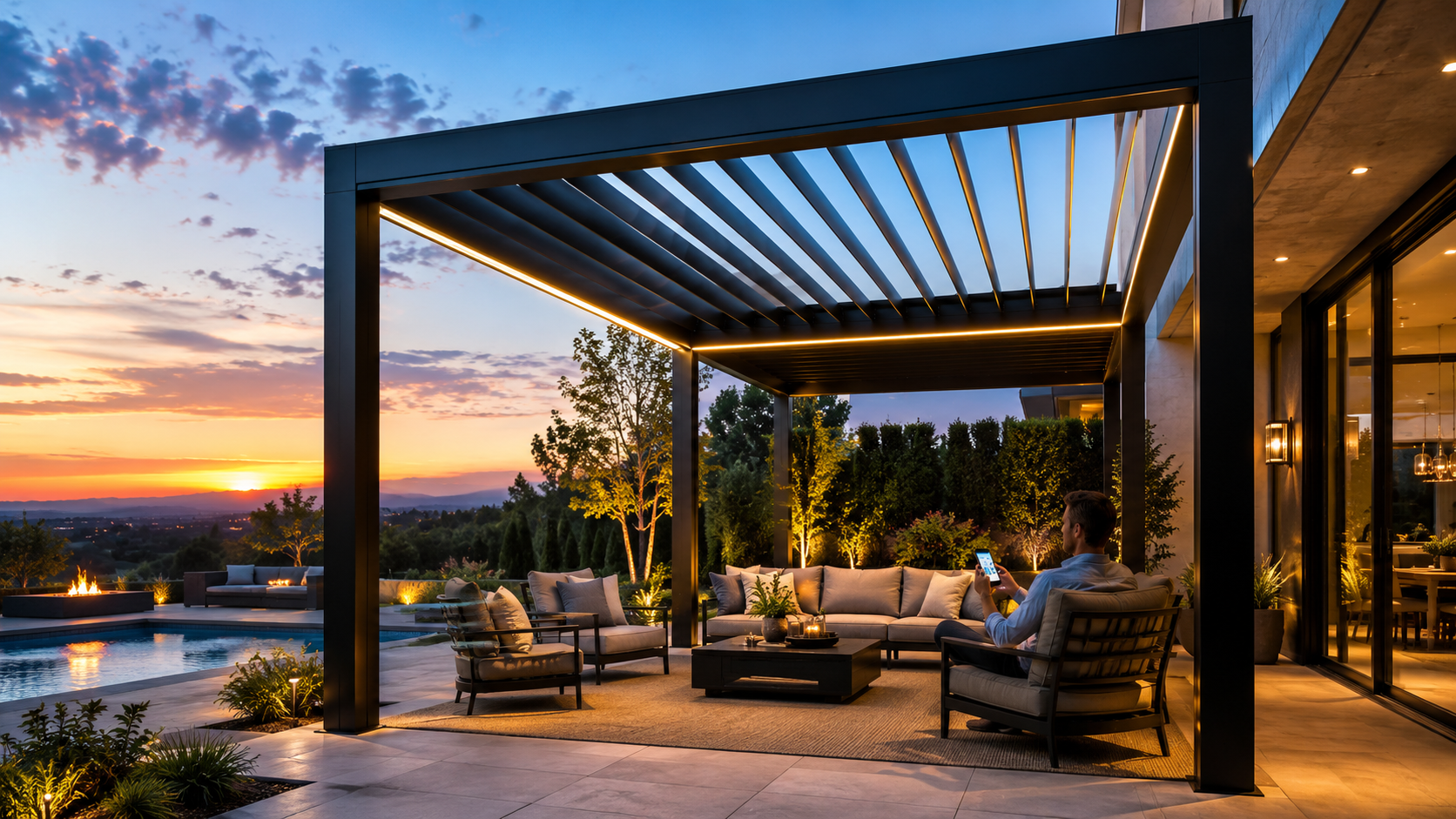
A motorized louvered pergola uses an electric motor to rotate adjustable aluminum roof blades from fully open to fully closed at the push of a button, via smartphone app, or through automated weather sensors. In 2026, motorized systems range from $3,900 for budget kits to $55,000+ for premium custom installations. The most popular residential motorized pergolas cost $8,000–$18,000. Leading motor brands include Somfy (premium standard, 50,000–100,000 cycle life), Nice/Elero, and Cherubini. Smart features include rain and wind sensors that auto-close louvers within 20–30 seconds, voice control via Alexa/Google/HomeKit, scheduling, and coordination with whole-home automation. Premium branded motors last 15–30 years; generic motors average 3–5 years. Motorized systems cost $2,000–$8,000 more than manual equivalents but dramatically increase actual daily usage and weather protection.
What Is a Motorized Louvered Pergola?
A motorized louvered pergola is the most capable outdoor shade structure you can add to your home: a rigid aluminum frame topped with a roof of rotating blades that open for full sunlight, tilt for filtered shade, and close into a watertight surface the moment weather turns — all driven by an electric motor you control with a button, your phone, or entirely by automated sensors. It represents the dominant category in the louvered pergola market for 2026, and for good reason. The motor eliminates the physical effort of manual adjustment, enables real-time automation, and supports integration with your broader smart home ecosystem. When industry experts say "louvered pergola" in 2026, they almost always mean the motorized version — it's become the default expectation for any serious outdoor living investment.
The motorized louvered pergola market has matured dramatically. Options now range from budget-friendly DIY kits starting around $3,900 to premium custom-installed systems exceeding $55,000. What separates these tiers isn't just size or aesthetics — it's the motor brand, aluminum alloy, sensor sophistication, and engineering documentation behind each system. The American Society of Landscape Architects has identified adjustable outdoor structures as a defining trend in 2026 residential design, with motorized pergola installations growing over 300% across major metropolitan areas. Outdoor living features now rank among the top five most desired home improvements, and well-designed motorized pergola systems can yield a return on investment of 70–80% through increased property value alone. For a deep dive into how outdoor upgrades affect home value, explore our guide to outdoor improvements that boost property value.
How Motorized Louver Systems Work: The Engineering Inside
Understanding the mechanical engineering inside a motorized louvered pergola helps you evaluate quality, anticipate maintenance needs, and make a better purchasing decision. The system is more elegant than complex — a well-designed motorized pergola has surprisingly few moving parts.
The Motor and Drive Mechanism
A small electric motor — typically 24V DC for safety (low voltage, no shock hazard) or 110–120V AC for higher torque — is concealed within the pergola frame, usually inside a beam or at a connection point invisible from below. The motor connects to a central drive shaft that runs the length of the pergola. Each louver blade is attached to this shaft via linkage arms. When the motor activates, it rotates the drive shaft, and the linkage arms translate that rotation into synchronized louver movement. This design ensures all blades move in perfect unison, maintaining consistent positioning across the entire roof surface.
Premium systems employ tubular motors — cylindrical electric motors housed within the drive shaft itself. These motors, typically rated at 230–280 watts for residential installations, generate sufficient torque to rotate louver assemblies spanning up to 24 feet wide. Power consumption during adjustment is minimal, averaging just 0.15–0.25 kWh per operation cycle — roughly 3–5 cents per use at typical U.S. electricity rates. Over a full year of daily use, motor electricity costs total less than $20.
Control Interfaces
Modern motorized louvered pergolas offer multiple control methods, often simultaneously. Wall-mounted switches provide simple on-site operation. Handheld remote controls allow adjustment from anywhere in the yard. Smartphone apps (iOS and Android) enable control from inside the house, from work, or from vacation. Voice commands through Amazon Alexa, Google Assistant, or Apple HomeKit add hands-free convenience. The most advanced systems combine all four methods, letting you choose whichever is most convenient in the moment.
The Sealing and Drainage System
When louvers close on a motorized system, they form a waterproof surface through precision engineering. Premium systems use dual-wall louver profiles with tongue-and-groove or overlapping edges that interlock when closed, leaving zero gaps. Rainwater flows along the closed louver surface into integrated gutter channels hidden inside the side beams. These channels route water down through hollow posts to ground-level drainage. This concealed drainage system is one of the most important differentiators between well-engineered motorized pergolas and budget alternatives. If the drainage system leaks, no amount of motor quality can compensate for a wet patio during rain.
Motor Brands Compared: Somfy vs Nice vs Cherubini vs Generic
The motor is the heart of a motorized louvered pergola — it's the one component that operates mechanically every time you adjust the louvers, making it the most likely failure point and the most important quality differentiator. Here's how the major motor brands compare:
| Specification | Somfy | Nice / Elero | Cherubini | Generic |
|---|---|---|---|---|
| Market Position | Premium standard | Mid-to-premium | Premium niche | Budget / entry |
| Cycle Rating | 80,000 – 100,000 | 50,000 – 80,000 | 60,000 – 90,000 | 10,000 – 30,000 |
| Expected Lifespan | 15 – 25 years | 12 – 20 years | 12 – 20 years | 3 – 5 years |
| Noise Level | ~40 dB (whisper-quiet) | ~42 dB (quiet) | ~38 dB (ultra-quiet) | 55 – 65 dB (noticeable) |
| Smart Home Integration | Widest (Alexa, Google, HomeKit, Control4, Crestron) | Good (Nice Home, Alexa, Google) | Moderate (own app, select platforms) | Basic remote only |
| Communication | Bidirectional (RTS / io-homecontrol) | Bidirectional | Bidirectional | One-way |
| Manual Override | Yes | Yes | Yes | Varies |
| Price Premium | Highest | Moderate | Moderate-high | Lowest |
The difference between branded and generic motors isn't subtle. A Somfy motor rated for 100,000 cycles at 40 dB will operate quietly and reliably for 20+ years of residential use. A generic motor rated for 15,000 cycles at 60 dB will be noticeably loud and may fail within 3–5 years — requiring a $500–$1,500 replacement that often involves partial disassembly of the pergola frame. In a $15,000 pergola, the motor represents perhaps $800–$1,500 of the total cost. Skimping on this one component to save $500 upfront is the single most costly mistake buyers make.
Smart Features and Home Automation Integration
Smart technology is what elevates a motorized louvered pergola from a convenient shade structure to an intelligent outdoor climate control system. The sensor and automation capabilities available in 2026 have matured to the point where your pergola can manage itself autonomously — responding to weather, time of day, and your personal preferences without any manual input.
Weather Sensor Systems
Rain sensors detect moisture on a dedicated sensor pad mounted on the pergola's highest point and automatically close the louvers within 20–30 seconds. This protects outdoor furniture, cushions, electronics, and anyone sitting beneath from unexpected showers. Wind sensors monitor air speed and automatically open louvers or lock them at a safe angle when winds exceed programmable thresholds (typically 25–35 mph). This prevents structural damage from dangerous uplift forces that could occur with closed louvers acting as a solid sail in high gusts. Temperature sensors adjust louver angles throughout the day to optimize shade as the sun's position changes, maintaining comfortable temperatures beneath the pergola without any human intervention. Snow sensors detect accumulation weight and auto-tilt louvers to shed snow before it exceeds the structural load rating.
App Control and Scheduling
Dedicated smartphone apps from motor manufacturers (Somfy's "iO by Somfy" is the market leader) allow you to control your motorized louvered pergola from anywhere with internet access. Beyond simple open/close commands, these apps enable customizable preset positions (25% open for morning coffee, 75% closed for afternoon shade), time-based scheduling (auto-open at sunrise, auto-close at sunset), and real-time status monitoring so you can verify louver position remotely. Reports indicate that 68% of motorized pergola buyers in 2025 opted for smart connectivity, reflecting the broader demand for connected outdoor living.
Voice Control
Integration with Amazon Alexa, Google Assistant, and Apple HomeKit means you can adjust your pergola with simple voice commands: "Alexa, close the pergola" or "Hey Google, set the pergola to 50%." This hands-free operation is particularly valuable when you're cooking at an outdoor kitchen, swimming in the pool, or hosting guests with full hands.
Whole-Home Integration
The most sophisticated motorized louvered pergolas coordinate with broader home automation platforms like Control4, Crestron, and Savant. This enables unified scenes — a "Movie Night" scene might close the louvers, lower the side screens, dim the integrated LEDs, turn on the outdoor TV, and activate the sound system simultaneously with a single command. Integration with HVAC systems can coordinate pergola shade with indoor cooling: when the pergola shades the living room windows, the air conditioner can reduce output, lowering energy costs. For a complete overview of outdoor-indoor technology integration, see our smart home outdoor integration guide.
Motorized vs Manual Louvered Pergola: Which Should You Choose?
This is one of the most common questions buyers face, and the answer depends on how you actually use your outdoor space — not just how you imagine using it.
| Factor | Motorized | Manual (Hand Crank) |
|---|---|---|
| Operation | Button, app, voice, or automatic | Physical hand crank each time |
| Adjustment Time | 15–90 seconds (motor-driven) | 2–5 minutes (manual effort) |
| Typical Cost | $3,900 – $55,000+ | $2,000 – $8,000 |
| Weather Automation | Full sensor-based automation | None — manual only |
| Smart Home Integration | Alexa, Google, HomeKit, Control4 | Not available |
| Electrical Requirement | 110V AC or solar panel | None |
| Failure Points | Motor, electronics, sensors | Crank mechanism (rare) |
| Actual Usage Pattern | Adjusted multiple times daily | Set once and left for hours/days |
Here's the behavioral insight that manufacturers won't emphasize: motorized pergolas get adjusted far more often than manual ones. When opening or closing requires walking to a crank and turning it for 3 minutes, most homeowners set the louvers once and leave them — even when conditions change. When the same adjustment takes a single button press from a lounge chair, homeowners adjust continuously throughout the day. This means motorized systems deliver dramatically more value from the adjustable louver concept because the louvers are actually adjusted to optimal positions rather than set once and forgotten. That's the fundamental argument for motorized: you're paying for the adjustability, and the motor ensures you actually use it.
How Much Does a Motorized Louvered Pergola Cost in 2026?
The motorized louvered pergola market spans from accessible DIY kits to architect-specified custom installations. Understanding the price tiers helps you find the sweet spot between your budget and the features that matter most.
What Drives the Price Spread?
Beyond size, five factors account for most of the price difference between motorized louvered pergola systems:
Motor brand and protocol: A Somfy io-homecontrol motor with bidirectional communication adds $800–$1,500 over a generic one-way motor. But it lasts 4–7× longer and enables smart home integration that generic motors cannot support.
Aluminum alloy and construction weight: Premium 6061-T6 aluminum costs 30–60% more than 6063-T5 but provides 2.5× the structural strength. A commercial-grade motorized pergola weighing 1,000–1,800 lbs uses dramatically more material than a 250–450 lb kit.
Sensor and automation tier: A basic system with a remote control and rain sensor adds $200–$500. A full suite with rain, wind, temperature, and snow sensors plus Wi-Fi bridge for app control and voice assistant integration adds $800–$2,500.
Coating quality: Multi-layer powder coating (AAMA 2604 or 2605 rated) resists UV fading for 15–20+ years, compared to 5–8 years for basic single-layer finishes. The difference is most visible in high-UV climates like the Sun Belt.
Installation complexity: Professional installation adds $2,000–$6,000. Electrical wiring for the motor (if not solar) adds $300–$1,200 for a licensed electrician. Permit fees vary by jurisdiction, typically $100–$500.
Benefits That Justify the Motorized Investment
✓ Why Go Motorized
- One-button or voice-activated operation from anywhere
- Rain sensors auto-close louvers in 20–30 seconds — protecting furniture even when you're not home
- Wind sensors prevent structural damage by auto-adjusting during gusts
- App control lets you check and adjust from work, vacation, or bed
- Scheduling automates daily comfort (open at sunrise, shade by noon)
- Smart home integration creates unified outdoor-indoor scenes
- Louvers actually get adjusted throughout the day, maximizing the system's value
- Increases property value more than manual systems due to smart features
- HVAC coordination reduces indoor cooling costs measurably
- Near-silent operation with premium motors (38–42 dB)
✗ What to Consider
- $2,000–$8,000 premium over manual systems
- Motor is a mechanical component that will eventually need replacement ($500–$1,500)
- Requires electrical connection (110V AC) unless solar-powered
- Electronics add complexity — more potential failure points than a crank
- Generic motors in budget models may fail within 3–5 years
- Smart features require Wi-Fi connectivity and occasional firmware updates
- Power outage stops motorized operation (manual override required)
The benefit that matters most is often overlooked: automated weather protection. If you're at work and a sudden rainstorm hits, a sensor-equipped motorized louvered pergola closes itself and protects your $3,000 outdoor sofa, $500 cushion set, and $800 outdoor TV. A manual pergola remains whatever position you left it in. One rain event that soaks unprotected outdoor furniture can cause more damage than the entire cost premium of choosing motorized over manual. For homeowners with high-value outdoor furnishings, the motorized option isn't a luxury — it's insurance.
7-Point Buying Checklist for Motorized Louvered Pergolas
Use this checklist to evaluate any motorized louvered pergola before purchasing. These seven factors predict long-term satisfaction more reliably than brand reputation, price point, or visual appeal.
1. Motor Brand Identification
Confirm the specific motor brand and model. Somfy, Nice, and Cherubini are the proven brands. If the manufacturer says "premium motor" without naming the brand, it's almost certainly a generic motor with a 3–5 year practical lifespan.
2. Manual Override Mechanism
Verify that the system includes a manual override — a detachable hand crank or hex key that lets you operate the louvers during power outages. This isn't optional. Without it, a power failure during a rainstorm means your louvers stay wherever they were, potentially leaving your space exposed. Premium systems also offer battery backup providing 3–5 emergency operations.
3. Bidirectional Communication
The motor's communication protocol matters. Bidirectional motors (Somfy RTS/io-homecontrol, Nice BiDi) send confirmation back to the controller that a command executed successfully. One-way motors send the command but can't confirm execution — so you won't know if the louvers actually closed when the rain sensor triggered. For any system with automated weather sensors, bidirectional communication is essential.
4. Wind Rating with Engineering Documentation
Motorized systems face a unique wind challenge: closed louvers act as a solid surface that catches wind loads. Verify the system's certified wind speed rating (80 mph minimum for most U.S. locations, 120+ mph for coastal/hurricane zones) and request the stamped engineering report. Also confirm that the wind sensor is calibrated to open or safe-angle the louvers before dangerous wind speeds are reached.
5. Drainage Performance Under Rain
A motorized system that closes automatically in rain but then leaks at every louver seam defeats the purpose. Ask for documentation or video showing sustained rainfall performance. Premium systems with dual-wall louvers and integrated gutters handle heavy rain without visible leaks. Budget systems with single-wall louvers and no gutter integration will drip.
6. Separate Motor Warranty
The motor warranty should be separate from the structural warranty. Look for 5–10 years of motor coverage from premium systems. If the motor is lumped into a general warranty that excludes "normal wear" or "electronic components," the motor may effectively have zero warranty coverage. Also check whether the warranty covers parts only or parts plus labor.
7. Smart Integration Compatibility
If smart home integration matters to you (and it should — it's the biggest functional advantage of motorized over manual), verify specific compatibility with your existing ecosystem before purchasing. Confirm whether Alexa, Google, and/or HomeKit support is native or requires a third-party bridge. Check whether the dedicated app supports both iOS and Android. Ask whether firmware updates are delivered over-the-air or require manual intervention.
Installation: Electrical, Solar, and DIY Options
Installing a motorized louvered pergola adds one critical step beyond standard pergola assembly: connecting the motor to a power source. Your three options each have distinct implications for cost, complexity, and ongoing operation.
Hardwired Electrical (110–120V AC)
The traditional approach routes household electrical power to the pergola motor through conduit buried underground or run along an exterior wall. This requires a licensed electrician for safety and code compliance, adding $300–$1,200 to installation costs. The advantage is unlimited, reliable power with no batteries to monitor. A dedicated 15- or 20-amp circuit is standard. Most building codes require GFCI protection for outdoor electrical connections.
Solar-Powered Systems
The fastest-growing category in 2026. Integrated solar panels (typically mounted on the pergola frame itself) charge a rechargeable battery pack that powers the motor and sensors independently of the electrical grid. Solar eliminates the need for an electrician entirely, reduces installation cost by $300–$1,200, creates zero ongoing electricity costs, and maintains operation during grid power outages. The trade-off: battery capacity limits the number of daily operations (typically 15–30 cycles on a full charge), and prolonged overcast periods can reduce available charge. For most residential use patterns (5–15 adjustments per day), modern solar systems provide more than sufficient capacity.
DIY vs Professional Installation
The structural assembly of a motorized louvered pergola (posts, beams, louver panels) follows the same process as a manual system and is DIY-friendly with manufacturer-provided kits. The motor and sensor installation is typically plug-and-play within the pre-engineered frame. The electrical connection is the only component that usually requires professional involvement. For solar-powered motorized systems, the entire installation can be genuinely DIY — from foundation to fully operational smart pergola — saving $2,000–$6,000 in installer labor. For complete guidance on outdoor project budgeting, see our outdoor renovation budget planner.
Motor Maintenance and Longevity Guide
A well-maintained motorized louvered pergola motor should operate for 15–25 years before replacement. The maintenance requirements are minimal but specific — neglecting them is the primary cause of premature motor failure.
Monthly: Operational Check (2 minutes)
Cycle the louvers through their full range of motion — fully open to fully closed and back. Listen for any unusual sounds: grinding, clicking, or increased motor noise. These can indicate early bearing wear, debris in the louver tracks, or linkage misalignment. Catching issues early prevents cascading damage that turns a $50 fix into a $1,500 motor replacement.
Quarterly: Track and Pivot Cleaning (10 minutes)
Clear any debris (leaves, pollen, grit) from the louver pivot tracks and linkage arms. Use a soft brush to remove accumulated material. These tracks are where the mechanical action happens, and grit in the pivot points forces the motor to work harder, reducing its operational lifespan. After cleaning, apply a light coat of silicone-based lubricant (never petroleum-based, which attracts more dirt) to all pivot points and the drive shaft connection.
Annually: Full System Inspection (20 minutes)
Test all control methods: remote, app, wall switch, voice command, and each sensor. Replace remote control batteries. Check the rain sensor pad for debris or mineral buildup that could reduce sensitivity. Verify that the wind sensor rotates freely. Inspect all visible wiring connections for corrosion or looseness. Clear the gutter channels and verify drainage flow. Check the motor housing for any signs of water intrusion. For solar-powered systems, clean the solar panel surface and check battery charge levels.
Motor Replacement Planning
Even premium motors eventually wear out. Plan for motor replacement at the 15–20 year mark for Somfy/Nice/Cherubini, or at 3–5 years for generic motors. Replacement costs $500–$1,500 including parts and labor. Building a modest repair reserve — setting aside $200–$300 per year starting at year 10 — ensures the cost isn't a surprise and is often more economical than extended warranty premiums.
Accessories That Complete Your Motorized Pergola
A motorized louvered pergola is the architectural foundation of a complete outdoor room. The accessories you add determine whether it becomes a basic covered patio or a fully equipped living space rivaling your indoor rooms. Here are the most popular add-ons:
Integrated LED Lighting
LED strips embedded in beams or along louver edges create ambient illumination controlled through the same app or remote that operates the louvers. Dimmable warm-white LEDs set the mood for evening entertaining. Some systems offer color-changing options and can be incorporated into smart home scenes — the same "Dinner Party" command that angles louvers to 60% can set the LEDs to warm amber at 40% brightness.
Motorized Retractable Screens
Adding motorized screens to the pergola's sides creates a convertible outdoor room. Screens lower or raise with the same app that controls your louvers. Options include insect mesh, sunshade fabric, privacy panels, and clear wind-blocking vinyl. The combination of a motorized adjustable roof and motorized retractable walls — all controlled from your phone — creates the most versatile outdoor space possible.
Infrared Heaters and Ceiling Fans
Infrared heaters mounted in the beam structure extend your outdoor season by months. Ceiling fans between louver rows improve comfort during hot weather. Both can be integrated into the same smart control system, creating temperature-responsive outdoor climate control: fans activate above 85°F, heaters activate below 55°F, and louvers adjust continuously throughout.
Outdoor Audio and Entertainment
Weather-resistant speakers built into the pergola beams deliver high-quality sound without visible equipment. Pair with an outdoor TV or projector for a backyard theater. With louvers closed, screens down, and integrated lighting set to dim, a motorized pergola becomes a genuinely immersive entertainment space.
Ready to Upgrade to Motorized Outdoor Living?
Explore our curated collection of premium outdoor products designed to complement your motorized louvered pergola setup.
Shop Outdoor Collections →Frequently Asked Questions About Motorized Louvered Pergolas
What is a motorized louvered pergola?
A motorized louvered pergola is an outdoor aluminum structure with a roof of adjustable slats (louvers) driven by an electric motor. Instead of manually cranking the louvers, you press a button on a remote, tap a smartphone app, issue a voice command, or let automated weather sensors handle adjustments automatically. The motor rotates all louvers simultaneously from fully closed (waterproof) to fully open (maximum airflow) within 15–90 seconds.
How much does a motorized louvered pergola cost in 2026?
Motorized louvered pergolas range from $3,900 to $55,000+ in 2026. Budget motorized kits cost $3,900–$8,000, mid-range systems with quality Somfy or Nice motors run $8,000–$18,000, and premium custom installations with full smart home integration cost $18,000–$55,000+. Professional installation adds 10–30% to material costs. The motor and electronics typically represent $800–$2,500 of the total system price.
Which motor brand is best for a louvered pergola?
Somfy is the premium market standard, with 50+ years of motorization expertise, the widest smart home integration (Alexa, Google, HomeKit, Control4, Crestron), and motors rated for 80,000–100,000 cycles (15–25 year lifespan). Nice/Elero is a strong mid-to-premium alternative with competitive pricing and good reliability. Cherubini is an Italian specialist known for ultra-quiet operation. Generic motors cost less but typically last only 3–5 years.
Can I control a motorized pergola with my phone?
Yes. Mid-range and premium motorized louvered pergolas include Wi-Fi connectivity and dedicated apps (iOS and Android) that let you control louver position, set schedules, save preset positions, and monitor system status from anywhere with internet. Somfy's "iO by Somfy" app and Nice's "Nice Home" app are the most widely used platforms. Budget systems typically include only a basic handheld remote without app connectivity.
What happens during a power outage?
Quality motorized louvered pergolas include a manual override mechanism — a detachable hand crank or hex key — that lets you open or close the louvers without electricity. Some premium systems feature battery backup providing 3–5 emergency operations. Solar-powered motorized systems maintain independent operation during grid outages since they run on stored solar energy. Always verify your system has a manual override before purchasing.
How long do motorized pergola motors last?
Premium branded motors (Somfy, Nice, Cherubini) are rated for 50,000–100,000 operational cycles, translating to 15–30 years of typical residential use at 10–20 daily adjustments. Generic motors in budget systems typically last 3–5 years with 10,000–30,000 cycle ratings. Motor replacement costs $500–$1,500 depending on brand and installation complexity. Setting aside $200–$300/year starting at year 10 builds a comfortable repair reserve.
Does a motorized pergola need an electrician to install?
For hardwired 110–120V AC systems, yes — a licensed electrician is recommended for safety and code compliance, adding $300–$1,200 to installation costs. For solar-powered motorized systems, no electrician is needed since the system runs on integrated solar panels and batteries. The structural assembly (posts, beams, louvers) is DIY-friendly with most manufacturer kits regardless of the power source.
Motorized vs manual louvered pergola: which is better value?
Motorized systems cost $2,000–$8,000 more but deliver dramatically more daily value because louvers are actually adjusted throughout the day rather than set once and forgotten. Over a 15–20 year motor lifespan, the premium works out to $100–$530/year for one-button convenience and automated weather protection. For homeowners with high-value outdoor furniture, the automated rain protection alone can prevent more damage in a single storm than the entire motorized premium.
Final Thoughts: Is a Motorized Louvered Pergola Right for You?
A motorized louvered pergola is the most advanced outdoor living structure available to homeowners in 2026. It takes the already-compelling concept of adjustable louvers and removes the friction that prevents you from actually using them — replacing a manual crank with silent motors, smartphone apps, voice commands, and intelligent sensors that respond to weather faster than you can.
The key to a successful motorized pergola purchase is focusing on three things above all else: the motor brand (Somfy, Nice, or Cherubini — never unnamed generics), bidirectional communication for reliable automation, and a manual override for power outage safety. These three factors predict long-term satisfaction more reliably than total price, visual design, or marketing claims about wind ratings and lifespan.
Whether you choose a solar-powered DIY kit that eliminates wiring entirely or a premium custom-installed system with full smart home integration, the right motorized louvered pergola will transform your outdoor space from a weather-dependent afterthought into a true extension of your home — one that adjusts itself to keep you comfortable, protects your investment in outdoor furnishings, and adds lasting value to your property. The best time to start enjoying your outdoor space year-round is now.


